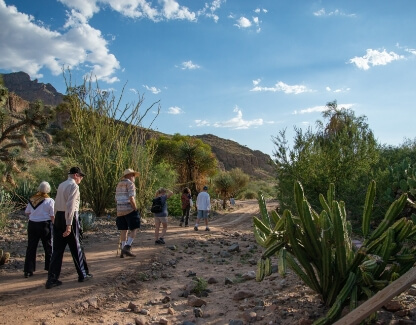
Edible and Medicinal Desert Plants Walking Tour September 23
at 8:30 a.m. with Mike Hills - Tours move to 1:30 p.m. October 13 and 28
EDITORS NOTE: Our September 23, Sunday, walk at 8:30 am will be guided by Mike Hills of the Arizona Herb Associatio. Jean Groen, seen at right, is scheduled to return as tour guide October 13, Saturday, when this route resumes a Fall and Winter start time at 1:30 p.m.
Jojoba seeds have a nutty flavor - and prickly pear cactus fruits yield than just a colorful margarita mixer -- they're nutritious and have a unique taste -- and are a Sonoran Desert staple so popular they have been exported worldwide. Boyce Thompson Arboretum is the place to learn about desert plants and their useful properties -- be here September 23 at 8:30 a.m for a guided walking tour where Mike Hils will interpret Edible And Medicinal Plants of the Sonoran Desert.
In October the tour is offered twice each month and moves to an afternoon start time at 1:30 p.m. on the Second Saturday guided by Jean, and on the Fourth Sunday each month lead by ethnobotanist and Choctaw Tribal Nation member David Morris. Visitors can explore our Curandero Trail and learn more about useful desert plants on your own, too -- ask for the self-guided Curandero Trail guide in our gift shop.
Don Wells and Jean Groen of Apache Junction are co-authors of "Foods of the Superstitions"which is available in our gift shop, where you'll also
find the more recent and expanded companion volume describing desert plants
and recipes: "Plants of the Sonoran Desert and Their Many Uses."
Published
in 2006, this newer book has 157 pages and describes how to identify and where
to find three dozen plants, their medicinal uses and how these plants have
been used by Sonoran Desert natives for hundreds of years.
Asked to name a few favorites, Jean says:
"There are
so many things you can make to eat and drink from parts of the plant. My absolute
favorite food to make from the pads, nopalitos in Spanish, is
a wonderful soup.
Nopalitos are good in salad, salsa, scrambled
eggs, and pickle relish using the nopalitos in place of cucumbers.
Prickly pear fruits, also called "tunas," are wonderful
made into brandied tunas. For beverages there are Prickly Pear
blush, prickly pear tea, cactus shakes, and my all time favorite: prickly
pear margaritas."
"We try to portray the Sonoran Desert for what it is: a wonderland
of mountains, rivers, trees, cacti, flowers, and wildlife to be enjoyed, used,
and left intact for generations to come," says Groen. Her new book contains
72 recipes, 47 color pictures, and a wealth of information. It is available
here at the Arboretum and also at the Superstition Mountain Museum in Apache
Junction, Tonto National Monument visitor center near Roosevelt Lake, at the
Casa Grande Ruins and the Besh Ba Gowah archaeological park in Globe.
Ethnobotanist and Choctaw Nation member Dave Morris explains ways that native plants have healed, fed and
clothed desert peoples for the past thousand years -- and shares his humor, puns and wit along with his breadth of botanical knowledge.
Morris is a fan of jojoba seeds, shown
in the photos at left and right. These acorn-size seeds can take on a mild hazlenut
flavor after being lightly roasted. Jojoba (Simmondsia chinensis) is also known by the nicknames "goat nut," deer nut and coffeebush
-- the latter from its reputation as an acceptable coffee substitute when
mature seeds are roasted. Waxy oil pressed from the nuts is widely used in
shampoos and skin lotions; tea brewed from jojoba leaves can sooth inflamed
mucous membranes.
Ask
Dave Morris about his favorite desert plant and he cites the agave. "Fleshy
leaves of the agave were the source of fiber (sisal) for the early desert
natives. The fibers would be used for cordage, rope, baskets, mats and sandals.
The heart of the agave was roasted and eaten and the leaf tea is thought to
relieve arthritic pain," said Morris. Learn more about this plant, about
creosote and others which continue to nourish, heal and clothe people of the
Sonoran desert. Here's another, too: Native Americans in the desert refer
to the mesquite tree as the "tree of life". The pods can be ground
up and they provided the main source of flour until the introduction of European
heat, rye and barley. The bark of the esquite can be boiled to produce a germ-killing
wash for minor cuts and scrapes. The Piipash (Maricopa) obtain
a black paint from mesquite bark that is used to add designs to their traditional
pottery."
"My second favorite
plant is the mesquite tree. Almost every part of the tree can be put to good
use. The Indians used it for medicine, food, tea, implements, weapons, twine,
and paint. I use the pods to make jelly and to make flour which can be substituted
in place of regular flour. You wouldn't want to substitute more than a half-cup
in each cup of regular flour. The mesquite flour will make the product sweet
so youmight want to decrease the sugar called for. Also, the mesquite flour
has much less gluten than regular flour so you might want to make note of
this when making yeast bread."
As with most other weekend guided tours the
edible/medicinal plants walk is included with regular park admission of $9
for adults and $4.50 for ages 5-12. Boyce Thompson Arboretum is affiliated
with the UA's College of Agriculture and Life Sciences, in addition to being
an Arizona State Park. UA students, faculty and staff may bring your CatCard
or University I.D. to save an addition dollar off admission!
Read about other weekend guided tours and events