Overview
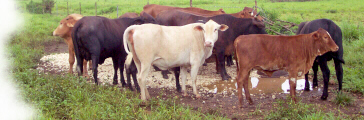
Concerns exist about the leaching, runoff, and discharge of nutrients and pathogens from livestock
effluent into groundwater and surface waters.
This problem is created by the expansion of many livestock and dairy production
operations that increase the number of animals while utilizing
the same land base, in order to stay economically competitive.
In Hawaii and the Pacific Island territories, the limited land area has
created special 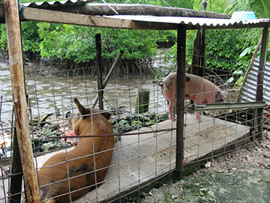 concerns in the management and disposal of livestock effluent.
Intense rainfall and tropical storms, along with the short path of pollutants to the receiving
waters, affect the water quality of the region. Besides contamination to sensitive coastal and coral reef environments,
piggery effluent represents a significant source of fecal contamination, and/or zoonotic disease. Pacific islands in the Regional Water Program that are affected by piggeries include the Northern Marianas Islands, American Samoa, Micronesia, and Palau. Adoption of the best animal waste management
practices can reduce the introduction of pollutants
from farms into the water supplies, helping to improve water quality. concerns in the management and disposal of livestock effluent.
Intense rainfall and tropical storms, along with the short path of pollutants to the receiving
waters, affect the water quality of the region. Besides contamination to sensitive coastal and coral reef environments,
piggery effluent represents a significant source of fecal contamination, and/or zoonotic disease. Pacific islands in the Regional Water Program that are affected by piggeries include the Northern Marianas Islands, American Samoa, Micronesia, and Palau. Adoption of the best animal waste management
practices can reduce the introduction of pollutants
from farms into the water supplies, helping to improve water quality.
Objectives
- Groundwater and surface waters (including streams, estuaries, coastal, and coral reef environments) are better protected from contamination by animal wastes
- Producers have a greater knowledge of nutrient cycles, environmental concerns, and the potential for zoonotic disease
- Livestock production economics are improved by implementation of whole farm nutrient management strategies
- Livestock producers are considered good stewards of the environment
Progress
The regional project supported development of two alternative waste management systems in the Pacific islands; a modified dry litter waste management system (DLWMS) and a portable pen. Workshops were conducted in the Northern Marianas, Guam, Micronesia, 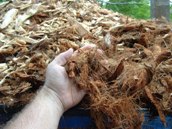 and Palau reaching over 150 farmer and agency participants. USEPA Region IX and Pacific Island Extension agents are optimistic regarding the dry-litter/composting approach and are actively pursuing voluntary adoption of the BMPs. Research conducted at the University of Nevada indicates that Leptospira appear to be best adapted to warm environments and neutral to slightly alkaline environments and can survive in fresh water or moist soil for months. This regionally supported research has identified ranges of temperature and pH conditions lethal to common variants of Leptospira. The information is critical for managing the pathogen, and has been requested by the Natural Resources Conservation Service (NRCS) Pacific Basin office for developing a composting standard to reduce the risk of off-site transport of spirochetes from infected pigs. and Palau reaching over 150 farmer and agency participants. USEPA Region IX and Pacific Island Extension agents are optimistic regarding the dry-litter/composting approach and are actively pursuing voluntary adoption of the BMPs. Research conducted at the University of Nevada indicates that Leptospira appear to be best adapted to warm environments and neutral to slightly alkaline environments and can survive in fresh water or moist soil for months. This regionally supported research has identified ranges of temperature and pH conditions lethal to common variants of Leptospira. The information is critical for managing the pathogen, and has been requested by the Natural Resources Conservation Service (NRCS) Pacific Basin office for developing a composting standard to reduce the risk of off-site transport of spirochetes from infected pigs.
Current Projects Under USDA NIFA
Alternative Waste Management Solutions for Small-scale Piggery Operations: Educational Outreach, Demonstration and Adoption for Pacific Island Communities
G.K. Fukumoto, University of Hawaii-Manoa
B. Rippy, L. Hirata and B. Matatumua, American Samoa
L. Duponcheel, Northern Marianas College Extension
C. Evensen, University of Hawaii
M. Duguies, University of Guam
M. Walker, University of Nevada-Reno
CONTACT
Glen Fukumoto
Phone: 808-322-4892
Fax: 808-322-4895
Email: gfukumot@hawaii.edu
Transport and Mitigation of Beef Cattle Veterinary Pharmaceuticals and Hormones in Surface and Sub-surface Runoff from Grazed Watersheds
K.W. Tate, University of California-Davis
This project assesses transport and fate of veterinary pharmaceuticals and hormones commonly used in beef cattle. Sustainable cattle production depends upon cattle production practices that maintain clean water for irrigation of food crops, human consumption and recreation, and aquatic habitat for sensitive species.
Read More >>
CONTACT
Kenneth Tate
Phone: 530-754-8988
Email: kwtate@ucdavis.edu
Past Projects Under USDA NIFA
An Alternative Waste Management System to Swine Operations for Water Pollution Control Programs in the American Pacific
Alan Sabaldica, Northern Marianas College Cooperative Extension
Lawerence Duponcheel, Northern Marianas College Extension
Carl Evensen, University of Hawaii
Glen Fukumoto, University of Hawaii
Conducted a series of workshops that introduced local pig farmers to two affordable and environmentally appropriate waste management systems for swine; the dry litter system, and the portable pen system.
Read More >>
CONTACT
Allan Sabaldica
Phone: 1 670 433 2576/0639
Fax: 1 670 433 2161
Email: Allans@nmcnet.edu
Demonstrating Best Management Practices on Piggeries in the Commonwealth of the Northern Mariana Islands
Lawerence Duponcheel, Northern Marianas College Extension
Carl Evensen, University of Hawaii
Demonstrated to sustainable agriculture operators the benefits of incorporating animal wastes as amendments to existing fertilization regimen for local cropping systems. The project will provide outreach to local farmers with the intent of demonstrating the agronomic value of animal waste amendments. This will encourage environmentally responsible behaviors in respect to the disposition of small-scale animal operation wastes. Demonstration will be accomplished by means of pilot site and local cooperator instruction.
CONTACT
Lawerence J. Duponcheel
Phone: 670-433-0639
Fax: 670-433-2161
email: lawontinian@pticom.com
Land Application of Livestock Manure in Hawaii and the American Pacific
Carl Evensen, University of Hawaii
Research is required to determine how nutrients from manures become available to crops and how these nutrients are retained, released, and utilized when applied to tropical soils.
Read More >>
CONTACT
Carl Evensen
Phone: 808-956-8825
Fax: 808-956-6539
Email: evensen@hawaii.edu
Leptospirosis and Compost Treatment
Mark Walker and John Parker, University of Nevada, Reno
Lawerence Duponcheel, Northern Marianas College
Brian Rippy, American Samoa Soil and Water Conservation District
To develop a reliable model of survival of pathogenic Leptospira spirochetes based on duration of exposure to ranges of temperature and pH expected in passive composting systems of the type that might be used in the western Pacific to reduce the risk of off-site water contamination with Leptospira spirochetes in piggery wastes.
Read More >>
CONTACT
Mark Walker
775-784-1938
fax: 775-784-4789
email: mwalker@cabnr.unr.edu |